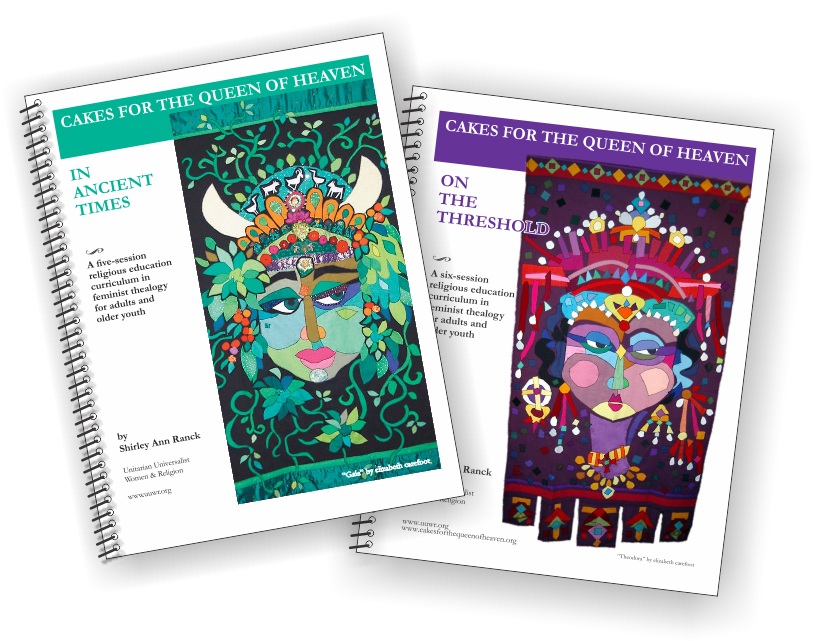
Welcome! The Women and Religion Movement is alive and well in the 21st Century. A grassroots project started by lay leaders in the 1970s as an effort to promote examination of religious roots of sexism and patriarchy within the UUA, UU Women and Religion officially began as a task force following the unanimously-passed WOMEN AND RELIGION RESOLUTION at the 1977 UUA General Assembly. Although the Task Force was eventually sunsetted, the movement still exists in UU Districts that hold Women & Religion programs and woman-focused gatherings. It exists at General Assembly, where UUW&R has an annual gathering and a booth in the display area. And it lives in the hearts and lives of women and men who have been touched by the many changes inspired by this movement. "We do not want a piece of the pie. It is still a patriarchal pie. We want to change the recipe!" -- Rosemary Matson
|
| videos and more about UUW&R |
New Book from Rev. Shirley Ranck

The Grandmother Galaxy is one woman’s journey into three spirals of learning that have emerged and confront us in the 21st century--women’s creative spirituality, a growing appreciation of our earthly home, and a deepening respect for the varied cultures created by human beings. In each of these spirals the image of a fierce and powerful old woman arises as central to our journey. If wise old women were visible and powerful perhaps we would all be better educated about the female half of our religious history. If we honored the crone as a symbol of our earthly transformation, the cycle of death and new life, perhaps we would be less likely to destroy the life-giving systems of our planet. If we learned to respect indigenous cultures where old women are still revered, perhaps we could stem the violence against women, and between cultures, that pervades so much of our world. The Grandmother Galaxy explores some of these possibilities and asks: Could a growing galaxy of grandmothers lead us onto new paths for the future?
IN STOCK NOW!
New UUA Curriculum for Reproductive JusticeUnitarian Universalists (UUs) are called to answer the chilling political debate on reproductive rights with calls for reproductive ‘justice’ and respect for the fullness of every person’s reproductive and sexual life. The election of the 2012-2016 Congregational Study/Action Issue, “Reproductive Justice: Expanding our Social Justice Calling,” is a milestone opportunity for Unitarian Universalists to live into this call. This curriculum was written to help UUs take on this call to action: www.uua.org/reproductive/calling/curriculum
January 22, 2013 marks the 40th anniversary of the landmark Roe v. Wade case which made abortion legal in the United States. Preaching on this topic would be a great way to launch the curriculum in your congregation. Ministers can sign up for the Reproductive Justice Clergy Caucus and find sermon resources at http://bit.ly/RoeSermonGuide Women and Mythology - Call for Papers
Lady of Ten Thousand Lakes: Finding Wisdom in Places Much of mythology is grounded in place. Suggested topics for this symposium might include, but are not limited to, the following: How do and should the scholarship in Goddess Studies and Women’s Mythology and Spirituality engage with the sense and reality of place? What women’s myths are especially grounded in a place or places? What happens when such disciplines as Natural History, Ecology, and other sciences of place interact with Women and Mythology?
Patricia Monaghan 1946-2012
http://www.patricia-monaghan.com/ http://en.wikipedia.org/wiki/Patricia_Monaghan says: Patricia Monaghan, Ph.D., (born 15 February 1946-died 10 November, 2012) [was] one of the pioneers of the contemporary women's spirituality movement.[1] She is the author of more than 15 books of poetry and nonfiction, including the two volume Encyclopedia of Goddesses and Heroines. She live[d] in Black Earth, Wisconsin (although she [held] dual Irish and American citizenship), where she and her husband Michael McDermott tend[ed] a vineyard and large organic garden. ... a wine expert,[2] and author of Wineries of Minnesota and Wisconsin, she [was] a founder of and Senior Fellow at The Black Earth Institute,[3] connecting earth, spirit and society through the arts. A Book To Tie Effective Feminism to Successful Elections
First, Latin American and Caribbean women sought only to share their governing power as citizens in democracies. They never put men in an adversarial position. Nor did they make them feel defensive. By seeking men as working partners and mentors, they avoided “gender warfare.” |


South American feminism is different from the US model according to journalist Barbara Frechette. She also adds that in several ways, it is better and could serve as a lesson in unity for
Please wait...